People often ask me, “Do I need to fuel during a long run?”
Here’s some things to consider:
If you are exercising for more than 60 minutes at a moderate-high intensity, consuming carbohydrates during your workout can help delay fatigue and enable you to perform at a higher intensity, it may also help you to continue exercising when your muscle glycogen stores are depleted.
What should I eat during a long activity?
It makes sense that the carbohydrates you consume during activities should be easily digested and absorbed. You need it to raise your blood sugar level and reach your exercising muscle rapidly. Whether you choose solid of liquid carbohydrate makes little difference to your performance, provided you drink water with solid carbohydrates. Liquid forms are more convenient as they provide fluid as well as fuel, which reduce dehydration and fatigue.
FUEL EXAMPLES
For exercise lasting longer than 60 mins: Carbohydrates only (easily digested and converted into energy)
NOTE: Practicing & experimenting with various foods is recommended during training. DO NOT try a new fuel on race day.
Raw Maple Ginger Sport Gel Recipe
Ingredients
15 ml pure maple syrup
Pinch of sea salt
Pinch of fresh ginger
Combine all the ingredients into a gel flask. Consume 15 ml every 45-60 mins into your run or ride!
Carole Woodstock, RHN, FIS, NCCP
www.fuel4lifenutrition.com
After you’ve had fun carving your pumpkin, save the seeds and make a healthy snack with the pumpkin seeds.
ROASTED PUMPKIN SEEDS
- 1 cup raw pumpkin seeds

- 1/4 tsp extra virgin olive oil
- Sprinkle of chili powder (you can also add paprika & cumin)
- Sprinkle of sea salt & garlic powder
- Wash the seeds, toss them with the olive oil and mix well. Add your spices & mix again. You can also change up the spices to your taste!
- Lay them out on a baking sheet and bake for 8-10 minutes at 350 degrees or until golden. Just watch them so they don’t get too brown.
Enjoy!
Carole Woodstock, RHN
www.fuel4lifenutrition.com
Stay energized throughout the day by feeding your ‘fire’.
Ever go camping and wait until the fire is nearly out before putting on another log? Ridiculous. It just smolders and smokes a whole lot, but doesn’t catch fire. You sit there, frustrated, wishing you had not waited so long. Your body is the same: waiting until you’re really hungry and going hours without food, will cause your metabolism to extinguish rather than keep your fire burning with a constant glow. Instead, keep your flame burning bright with healthy snacks! You will avoid the lows and curb the temptation to binge on those irresistible, high-sugar, high-fat holiday treats.
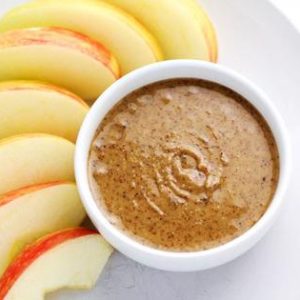
Apple slices with almond butter? Yes please!
Here are some easy snack ideas to get you going:
- Apple slices dipped in almond butter or sprinkled with cinnamon and chia seeds
- Nut and seed mix (almonds, walnuts, sesame seeds, pumpkin seeds)
- Kale chips (see recipe & video on fuel4lifenutrition.com in recipe section)
- Dates stuffed with crunchy raw almonds (take out each pit and replace with an almond or almond butter & cinnamon)
- Hard-boiled egg with raw veggies
- Avocado with sunflower seeds & sea salt (remove pit and replace with seeds & dash of sea salt)
- Celery sticks with natural peanut butter
Happy snacking!

| Dietary Reference Intake for Calcium (Source: Health Canada) |
||
| Age | Mg / Day | |
| Infants | 0-6 months | 200 |
| 7-12 months | 260 | |
| Children | 1-3 | 700 |
| 4-8 | 1000 | |
| 9-18 | 1300 | |
| Females/Males | 19-50 | 1000 |
| Males | 51-70 | 1000 |
| Females | 51-70 | 1200 |
| Females/Males | 71+ | 1200 |

“To err is human, to moo, bovine”
Many people come to me worried that they have to give up milk because of an intolerance to cow-dairy. But, where will I get my calcium from? My answer is: Don’t worry! There are many ways to ensure you will get enough calcium both from eating non-dairy sources of calcium and taking care to ensure that you hold on to the calcium your body already has.
Calcium myths:
- Everyone needs to drink (cow’s) milk
Not true. The most common allergy is to milk and cow-dairy products. You can be intolerant to either the lactose (sugar) or any of the 25 different proteins in milk which is why lactose-free milk is not always the answer. Most of us actually develop lactose intolerance in early adolescence but don’t realize it and keep drinking milk even though we experience gas, bloating, constipation, diarrhea and any other number of symptoms. If you are intolerant to cow-dairy, your body is unable to digest the dairy and absorb the calcium. As well, you can lose calcium from your body because the undigested lactase will ferment in your intestines and create lactic acid. Calcium is then leached from your bones to counteract the acidity.
- Dairy products will help prevent osteoporosis
Pasteurized milk contains 50% less calcium than non-pasteurized milk. Low fat milk makes it more difficult to absorb the calcium that’s left because fat is necessary to transport and absorb calcium. Research shows that countries with the highest dairy consumption often have the highest rates of osteoporosis.
Getting enough is just as important as avoiding losing what you already have:
In addition to getting enough dairy from your diet, here are some ways you can help your body to hold on to the calcium it’s got:
- Reduce intake of coffee, tea, soda, salt, and chocolate (caffeine intake causes calcium loss via urine)
- Reduce or avoid refined sugar (reduces absorption rate of calcium in the intestines)
- Reduce phosphorus intake: Meats, grains and sodas are very high in phosphorus which binds with calcium. If too much phosphorus is in your blood it will pull calcium from your bones. Consuming too much phosphorus is the same as not consuming enough dairy.
- Consume calcium with vitamin D (eggs, liver, mushrooms, the sun!)
Best diet to prevent calcium loss
- Not too much protein
- Includes good fats but not bad fats (trans fats, hydrogenated oils)
- High in complex carbs (fresh vegetables, whole grains, legumes, nuts/seeds, fruit in moderation)
Cow-Dairy Sources of Calcium:
| Food | Serving Size | Calcium mg/serving |
| Milk | 1 cup | 315 mg |
| Cheese | 1 oz | 130-200 mg |
| Cottage cheese | 4 oz | 100 mg |
| Plain yogourt | ½ cup | 200g |
Non-Dairy Sources of Calcium
| Food | Serving Size | Calcium mg/serving |
| Orange juice, calcium fortified | 1 cup | 300-350 mg |
| Rice milk, fortified | 1 cup | 300 mg |
| Almonds | ½ cup | 300 mg |
| Sesame seeds | 1/8 cup | 275 mg |
| Sardines, canned with bones | 6 medium | 275 mg |
| Tofu | 1 cup | 258 mg |
| Salmon, sockeye, canned with bones | ½ can | 245 mg |
| Soybeans | ½ cup | 230 mg |
| Almond butter | 3 oz | 225 mg |
| White beans, cooked | 1 cup | 170 mg |
| Baked beans | 1 cup | 163 mg |
| Blackstrap molasses | 1 tbsp | 137 mg |
| Home-made almond milk (see recipe below) | 1 cup | 75 mg |
Other sources of calcium:
- Vegetables (artichoke, asparagus, avocado, beans, broccoli, cabbage, carrot, collard greens, kale, okra, parsley, peas, spinach, swiss chard, turnip greens, watercress)
- Nut butters (cashew butter, tahini, all-natural peanut butter, sunflower seed butter)
- Beans and Rice (brown rice, chick peas, kidney beans, navy benas, pinto beans, wild rice)
- Seaweed (Agar, Irish moss, kelp, wakame)
Hidden sources of cow dairy on food labels:
Artificial butter flavour, butter, butterfat, buttermilk, casein, caseinates, curds, custards, half and half, hydrolysates, lactalbumin, lactose, nougat, pudding, rennet casein, sour creams, sour milk solids, whey, yogurt.
Make your own almond milk!
Soak ½ cup of raw almonds in water overnight. Rinse and drain. Remove skin (optional). Add to blender with 2 cups of filtered water and blend until smooth. Drain through 3-4 layers of cheese cloth to remove pulp. Store in fridge for 2-3 days; shake or stir if necessary as separation will occur.
References:
- Bateson-Koch, Carolee. Allergies: Disease in Disguise. Books Alive, 1994.
- Case, Shelley. Gluten-Free Diet: A Comprehensive Resource Guide. Case Nutrition Consulting, 2002.
- Shulman, Joey. Winning the Food Fight: Every Parent’s Guide to Raising a Healthy, Happy Child. Wiley, 2003.
With up to 70% of our bodies made up of water, it is a vitally important nutrient and one which many of us do not get enough of regularly. Water plays many important roles: It helps to remove toxins from the body; it nourishes our body’s cells and enables many chemical interactions to take place. Water also helps to regulate the body’s temperature. Efficient waste removal is essential for a healthy mind and body and will also help with weight loss and clearer complexion. Even if you do nothing except to increase your water intake, you will help your body remove excess toxins and waste.
On the contrary, if you do not drink sufficient water, you will become dehydrated and may feel more tired, lethargic and unmotivated. Many of us are dehydrated and don’t even realize it. The next time you have a headache and want to reach for the Tylenol, try drinking one to two glasses of water and waiting 30 minutes to see if your headache goes away. I bet you it will!
How much?
As you’ve probably heard before, you need between 8 and 12 glasses of water daily – even more if you exercise. To be more specific, take your body weight in pounds and divide by two – the result will be the minimum amount of water that your body needs (i.e. 120 Lbs ÷ 2 = 60 oz of water) daily. Of course if you exercise, you will need a bit more – approximately 500 ml per hour of exercise.
What type?
In addition to quantity, quality is also important.
Tap water purity can vary from location to location and many chemicals are added in order to render it fit for human consumption. Tap water is a source of chlorine, aluminum and in some areas, lead, radon and nitrates may also be a concern. To be on the safe side, you would do well to consider one of the following filtering options:
- BRITA (or similar): Brita filters use tiny charcoal fragments to filter your water of many hazardous chemicals. Brita pitchers and filters are easily obtained at most stores. It is very important, however, to change your filter regularly as failure to do so can allow other harmful bacteria to proliferate in between all the tiny charcoal granules.
- Bottled water: A popular option for many but the source of such water is sometimes questionable and it is also difficult to know how long the water has been sitting in the bottle and in which conditions. Many studies have shown that plastic can leach into the water over time and we also have to figure out how to dispose of the toxic plastic bottles.
- Reverse Osmosis: Considered by many to be the best source of pure water but a drawback of this method is the amount of water that must be wasted during the filtering process.
- Block carbon filters: My favourite. These are easy to install under your sink, water quality is good, there is minimal water wastage and they are more economical over the long-term than Brita filters. You can find a wide range of options at your local hardware store, e.g. Canadian Tire or Home Depot.
So I’ve had a pretty interesting couple of weeks: I purged my pants collection and only kept those pairs that made me feel fabulous. I decided not to do a fitness show in lieu of eating well for health. I’ve been busy.
It’s been exhausting, to be honest. But I can’t believe how much I’ve learned in such a short time.
The biggest lesson of this week was handed to me by Karen, our amazingly knowledgeable Holistic Nutritionist. I made an appointment with her when I realized how stressed out I’d been, and spent an hour and a half filling her in on the details of my eating, sleeping, elimination and exercise patterns.
I’m astounded by how cathartic just the assessment was; it was like seeing a psychotherapist and divulging my mental health issues (which, I suppose food issues are, anyway).
Our follow-up this past week left me reeling. As I had suspected, I was teetering on the edge of adrenal fatigue. For the uninitiated (like I was), adrenal fatigue is when your adrenal glands are releasing too much stress hormones (cortisol and epinephrine) and causing your system to be out of whack. I could go into a whole slew of jargon here, but the long and short of it is this:
Too much adrenal stress leads to poor digestion, fatigue, and unstable blood sugar, all of which I was experiencing.
Poor digestion leads to me feeling yucky, bloated, and fat, which leads to more stress.
Fatigue and unstable blood sugar leads to lots of coffee drinking and cravings galore, which then leads to me eating crappy, not digesting well, and feeling yucky, bloated, and fat… wait, didn’t I just say that?
Basically I was trapped on the hamster wheel of stress, and my body was like, Until you fix the problem, I’m not going to listen to you.
No wonder I wasn’t leaning out like I wanted to!
Talking to Karen was enlightening and refreshing. Being in the fitness and health industry for over 15 years has taught me a lot, but it’s interesting to note that none of my knowledge helped any when the focus was me. I was blind to what I needed. I needed help, and she was it.
So. I’ve started a plan to fix all of this hamster-wheel crap. At Karen’s recommendation, I started a few supplements designed to get my digestion back on track. I’ve eliminated some foods (and caffeine – ughhhhh) for ten days to stop the over-stimulation of my adrenals.
Side note: Have you ever tried to stop coffee cold turkey? SO not enjoyable. I had to wean off; it wasn’t fun. But after only 3 days I feel markedly clearer in the head. Win!!
In addition to the supplements and food changes, I’ve also been given strict instructions to take an hour of “me time” every day. I balked at that at first – do you know how busy I am, Karen? But then I realized that an hour (sometimes taken in 10 minute chunks) is not a whole lot of time.
I can do me time for 15 minutes before the little one wakes up. I can do it on my lunch hour at the gym. I can do it driving home listening to whatever kind of music I want, car-dancing my head off. And I can do it at night before bed with a book or a TV show with Husband Jamie. It’s doable.
It’s been 3 days, and I’m already optimistic. I feel clearer, more alert, and already I can feel a positive change in my stomach. I’m starting to feel satisfied after meals instead of crave-y, and even though I thought I wanted more coffee just now, I was pleasantly satisfied with green tea.
Can I change? I think so. It’s happening. One step at a time, and with some help, but it’s happening.
The journey continues.
Jen Wright is an RMT and the owner of Whole Therapy. She is an avid gym-goer and loves to lift heavy stuff. She sees clients of all ages and stages, especially those who are engaged in bettering themselves. She believes that pain-free is possible. For more about Jen, click here.