
Today is international women’s day, and we wanted to ask our own Tara Hagan-Fields, RMT a few questions about what it means to be a Women’s Health focused practitioner. Why did you decide to focus your practice on Women’s Health? I chose to focus my practice on Women’s Health because at the time I truly felt that there were too many therapists that were focusing in on general health and wellness. There weren’t enough therapists with a voice and a specialization in anything specific, especially not in the women’s health field. I was a new grad in a world of many RMT’s. I graduated with 30+ fellow colleagues in 2006, we all had the same level of training and the same knowledge base that we had learned while in school. I immediately needed to separate myself from the group as an individual who understood something more then the rest. I had developed a passion for the treating of pregnant women while in school, so after graduation, I immediately went after more courses! I felt I needed to learn more!. Along the way I grew as a therapist and as a woman. I recognized my passion was more then just treating pregnant women; It actually was more about treating all women, and women’s health related issues. Today I am completely
Q: How do you feel about massaging women?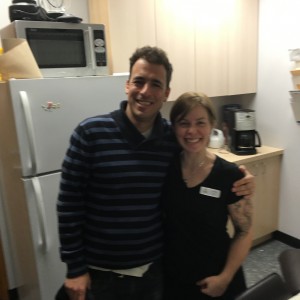 A: Most of my clients are women. I feel that I’m able to give a good, therapeutic, intuitive massage. I’m not judgmental of women’s bodies; I treat all of my clients with the respect they deserve. Q: And how about massaging men? A: In my experience, men who ask for a male therapist usually want deeper tissue massage, which is great for me because that’s what I like to do! Deep tissue focuses on the therapeutic aspect of massage. It’s a major part of what I do. Q: What are your feelings about being a gender minority in the massage world? A: I look at my job from the perspective of a massage therapist, not from that of a man. Unfortunately, massage therapy is still confused with intimacy, which it is not. It’s assessment, it’s treatment of soft tissue injuries. It’s an hour on the table working on your muscles. It’s therapy. Your therapists sex has nothing to do with it. Q: What would you say you focus on during treatments? A: Pain is often what brings clients in. I always address pain first – it’s a symptom that shouldn’t be ignored. Once the pain goes away, I focus on funct
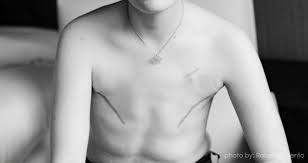 Pain and tightness suffered post mastectomy/ lumpectomy can limit one’s life drastically. Myofascial Release can help create vast changes by softening dense scars and fibrosed fascia that remain unchanged with traditional therapy and stretching. Traumatized tissue can have a cascading effect on the body. Locally, tightened and fibrous fascia can restrict blood flow and lymphatic flow resulting in lymphedema. Auxiliary cording can also occur, causing a significant loss of range of motion in the shoulder, leading to a loss of function. Pain and weakness can occur in the shoulder, arm and chest wall. Burning, pins and needles, numbness, or spasms can also occur in these areas. Tightness, with time, can start to effect areas not associated with the scar even if these areas are far removed from the local site. Symptoms not “normal” to mastectomy, lumpectomy, reconstruction, or augmentation can start to occur. Headaches, jaw pain, low back pain, pelvic pain, digestive issues, postural changes, hormonal imbalances, etc, may become a “common” occurrence for you. The inability to move, or the pain suffered with common range of motion and activity c
Every April, I pull out my Slo-pitch ball bag. Curse at myself for not having done it in October… Curse some more because that’s where my shirt went, or my favorites socks…. and then….curse some more because I left everything in the bag wet…. OOOOPS! I start the process of airing out the equipment, oiling up the glove, make sure there is a ball for every league, 11 inch for ladies, 12 inch for mixed. My warmup balls, one heavy, one regular weight. My bats are all cleaned up. My cleats cleaned and sprayed to rid of the smell. That’s my routine. I am a full time athlete only part of the year, because I only play ball from May to October. But, during my season I go all-out. I play on 3-4 teams, leagues and tournaments…. then the rest of the year is for rehabbing nagging injuries that happened during ball season. BUT… this year has been a little different. This year, instead of worrying about old injuries or worrying about a tweak here or there, I have been very worried about a new injury. One that impacts my game so much, that I have pulled myself from my line ups, just so I can rehab it to play in the year end tournaments. One that prevents me from lifting heavy objects, or thinking about how might I move my body during a treatment so I don’t feel this discomfort I am constantly feeling. I am often asked “who takes care of you?” and jokingly I reply “I get
Dictionary.com defines change as the following:
CHANGE verb (used with object), changed, changing.
To make the form, nature, content, future course, etc., of (something) different from what it is or from what it would be if left alone: To change one’s name; to change one’s opinion; To change the course of history. What a simple, easy to understand, straight to the point definition. And yet, as simple as it is to understand, why then do we humans have so much trouble implementing change into our own lives? I’m not talking about changing the tires on your car, or, the vacuum bag, or your little human’s diapers; although some of these things are dull, taxing, or unpleasant. I’m talking about real change. Meaningful life-altering change. Four years ago I found myself in a terrible position. I was stuck in a dead end job with no further room for growth. I wasn’t learning any new skills or even really developing my current skill set. The monetary compensation was less than adequate, and I was oh, so very bored. I can look at that time now and easily identify these symptoms for what they were: I was stuck. I needed a career transplant. I was trapped in this Grand Canyon-sized rut where it became easier to do nothing than to fix my situation. I had absolutely no idea how to g
My first experience witnessing our body’s natural ability to move freely, unwind, and heal from our past was in Chicago over 4 years ago. The course I was taking was offered by John F Barnes, a Physiotherapist known all over the world for his work in Myofascial Release. Seven years earlier I had read about Barnes during Massage school; now I was finally learning from him. On our first day, as I watched a fellow therapist walk up to the stage, I thought I had walked on to the set for America’s Funniest Home Videos. After a quick evaluation, she got on the table. We all sat there listening to what John was saying and watching him stay in one place holding the barrier (meeting the tissue resistance and staying there) on this therapist. As we watched, she started to shake as though she were cold and she began to move without any encouragement or assistance from John. Her movements were quite graceful, almost like a dance. Then she froze in space, not moving from a v-sit position. She wasn’t there long, maybe 2 breaths before her body relaxed again on the table. The whole time, John was holding the barrier never moving, never changing his pressure. A few thoughts went through my head: 1st, OMG, what the hell have I just got myself into? 2nd, Are these cameras here for these prank shows? And 3rd, Have I just wasted a lot of money to be here?
So you’ve gone and hurt yourself, huh? You’re a gung-ho weekend warrior with a twinge in your back and aren’t sure what to do about it. This isn’t unusual. We get all kinds of people coming through our doors who’ve injured themselves in brilliant and creative ways. As I sit here compiling this literary masterpiece, a client walks in with back spasms that are causing him visible discomfort. “How’d that happen?” I say. “I was choking on some long grain rice and coughed so violently that I threw my back out” he replies. Believe me when I say we’ve seen and heard it all. You may find yourself asking “What kind of treatment am I supposed to get?” With all the various types of sprains and strains you may be unlucky enough to receive, where to start can be an overwhelming decision. Here are a few things to consider: 1.What is your level of pain? If you’ve got a full-scale broken back, you’re going to want the emergency room and not deep tissue massage. An honest evaluation of the pain you are in/damage you have done is important at this stage. Open wound? Hospital. Arm dangling at a weird angle where you KNOW there isn’t a joint? Hospital. Tightness in the lower back after trying the caber toss for the first time? Whole Therapy!
Ladies ladies ladies! Let’s talk about bras and how they support us, or don’t. They are meant to aid a beautiful part of our body! However, I have been seeing a running theme in my practice lately and even out and about on the street. Ladies, why are you wearing ill-fitting bras with absolutely no support?
I hear all the excuses…”oh this is just my lazy day”, or “this is my bad bra”, or “my other one is in the laundry”, or “I just came from a work out”…again, all the excuses! Bras that you bought 10 years ago, throw them out! Even ones you bought 2 years ago, look at them closely! Does the elastic still support you the same way? Does the cup? Have you washed them…and dried them? How many do you have in a rotation? Why do I bring up this subject? We can’t take our breasts off like we can our bras. We need to support them! We honour our bodies with exercise and nutrition, so why do our breasts hang low and depressed!? If you have not been fitted, go get fitted! If you continue to wear the ill fitting bras, the drag will exacerbate poor posture, which can put aberrant stresses on your neck, shoulders and back. Poor posture can also impair breathing capabilities. There are some wonderful places here in Ottawa that are both fabulous and more importantly educated on proper fi