
Today is international women’s day, and we wanted to ask our own Tara Hagan-Fields, RMT a few questions about what it means to be a Women’s Health focused practitioner.
Why did you decide to focus your practice on Women’s Health?
I chose to focus my practice on Women’s Health because at the time I truly felt that there were too many therapists that were focusing in on general health and wellness. There weren’t enough therapists with a voice and a specialization in anything specific, especially not in the women’s health field.
I was a new grad in a world of many RMT’s. I graduated with 30+ fellow colleagues in 2006, we all had the same level of training and the same knowledge base that we had learned while in school. I immediately needed to separate myself from the group as an individual who understood something more then the rest. I had developed a passion for the treating of pregnant women while in school, so after graduation, I immediately went after more courses! I felt I needed to learn more!. Along the way I grew as a therapist and as a woman. I recognized my passion was more then just treating pregnant women; It actually was more about treating all women, and women’s health related issues.
Today I am completely centered on Women’s Health. I am different than most Massage Therapists in that I specialize in Myofascial Release and use those protocols to help every single woman who enters my treatment room.
Why does women’s health need a category of its own?
For years, there have been “fringe” conversations about women’s health related issues, but it has always been a very whispered conversation. The topic seemingly taboo. NO MORE! We as women have very specific health issues and they should never have to be whispered about. Incontinence, painful intercourse, mastitis, endometriosis, and infertility just to name a few. The list is long! Women should continue to demand better advocacy and better research on these and other important areas of Women’s health.
More practitioners are starting to dive in to niches and truly specialize in specific fields like Women’s Health, but more are needed. I look forward to the day when no woman needs to medicate because of conditions they are experiencing, where they can self treat and or go see their RMT to help rid of the source of pain.
What kinds of treatment do you provide specifically for women?
I do treat women of all ages, from babies to geriatric. Most of the women I see are looking for another kind of care. Something that will help them with conditions that they are currently experiencing, or ones they have had and suffered for years with: Chronic pelvic pain, jaw pain, headaches, endometriosis, infertility, breast pain, chronic back pain, scar work (laparoscopic, c-seciton, mastectomy, augmentation), pre- surgical care, fibromyalgia, incontinence, painful intercourse, post partum care, latching problems. My approach to massage therapy through myofascial release will help!
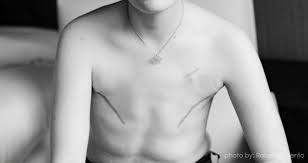 Pain and tightness suffered post mastectomy/ lumpectomy can limit one’s life drastically. Myofascial Release can help create vast changes by softening dense scars and fibrosed fascia that remain unchanged with traditional therapy and stretching.
Axillary cording is a web of thick, rope-like structures under the skin of your inner arm. These cords usually start near the site of your scarring in the underarm region and extend down the inner arm to the inside of the elbow (sometimes they can continue down to the palm of your hand, or in to the chest wall instead of, or in addition to, the inner arm.
Traumatized tissue can have a cascading effect on the body. Locally, tightened and fibrous fascia can restrict blood flow and lymphatic flow resulting in lymphedema. Auxiliary cording can also occur, causing a significant loss of range of motion in the shoulder, leading to a loss of function. Pain and weakness can occur in the shoulder, arm and chest wall. Burning, pins and needles, numbness, or spasms can also occur in these areas.
Tightness, with time, can start to effect areas not associated with the scar even if these areas are far removed from the local site. Symptoms not “normal” to mastectomy, lumpectomy, reconstruction, or augmentation can start to occur. Headaches, jaw pain, low back pain, pelvic pain, digestive issues, postural changes, hormonal imbalances, etc, may become a “common” occurrence for you.
The inability to move, or the pain suffered with common range of motion and activity can become debilitating. This might happen immediately, or it might occur 6 years down the road. In real life it might look like the inability to wash your hair in the shower, get dressed in the morning, pick your child up out of the crib, hug a loved one, carry your groceries, drive your car, work at your computer, or reach up and grab the sugar out of the cupboard. No matter the role you have as a woman - mom, worker, grandma - your life is impacted.
Pain management and rehabilitation using Myofascial Release can help. Gentle and slow work done at the fascial barrier (on the scar and surrounding areas) can assist in restoring functional patterns by decreasing the restrictions.
Whether you had surgery, chemo, or radiation last month or 10 years ago, Myofascial Release should be added to your recovery process.
Tara Hagan-Fields is an RMT with Whole Therapy. Tara is a Women’s Health Specialist and Myofascial Release Therapist. She focuses on the body as a whole and teaches you to do the same. More about Tara here or find her on Facebook Tara Hagan-Fields RMT
Every April, I pull out my Slo-pitch ball bag. Curse at myself for not having done it in October… Curse some more because that’s where my shirt went, or my favorites socks…. and then….curse some more because I left everything in the bag wet…. OOOOPS! I start the process of airing out the equipment, oiling up the glove, make sure there is a ball for every league, 11 inch for ladies, 12 inch for mixed. My warmup balls, one heavy, one regular weight. My bats are all cleaned up. My cleats cleaned and sprayed to rid of the smell. That’s my routine.
I am a full time athlete only part of the year, because I only play ball from May to October. But, during my season I go all-out. I play on 3-4 teams, leagues and tournaments…. then the rest of the year is for rehabbing nagging injuries that happened during ball season.
BUT… this year has been a little different. This year, instead of worrying about old injuries or worrying about a tweak here or there, I have been very worried about a new injury. One that impacts my game so much, that I have pulled myself from my line ups, just so I can rehab it to play in the year end tournaments. One that prevents me from lifting heavy objects, or thinking about how might I move my body during a treatment so I don’t feel this discomfort I am constantly feeling.
I am often asked “who takes care of you?” and jokingly I reply “I get around”. The honest truth…I struggle to even get my own treatments at times. Until recently! I have had to make it a priority to get in and get treated. And I’m not being easy in just finding any therapist to treat me, I am being very specific in who I see. I fully believe in Myofascial Release and how everyone needs it and that it will help everyone. I also know the people I work with are awesomely gifted in what they do. So in the past four weeks, I have been seeing my fellow colleagues here at Whole Therapy and some other MFR therapists here in the city, and I have also been self-treating!
4 weeks in a row, I have focused on getting someone else to touch and treat me. And 4 weeks in a row, I have focused on treating myself. Two weeks ago, after a great treatment and some self care that night, I felt a shift. I woke up for the first time and the pain wasn’t a burning sensation in my forearm and elbow. For the first time, I felt a good heat in my elbow rather than a horrible one. I’m feeling less nerve pain and I can hold my own coffee mug (you all know how much I love my coffee!).
My lessons are many this year…I need to take care of me (so our #ChangeOneThing challenge could not have come soon enough)! I need to make the time to get my own care even if I have to push something else aside to do it. I’ve always been a believer that no matter what it costs, we should take care of ourselves. This ball season, I feel it has cost me a lot; I have missed out on playing the sport I love with the people I like most. I have even come to the point that I don’t want to play ball because it hurts too much and my play has been impacted.
I am not invincible. I really need to practice what I preach about self-care and maintenance. I really have to be that athlete that gets treated regularly because my fascial restrictions have prevented me from doing what I love to do.
So my first #ChangeOneThing is to look at my schedule and put treatment into it for the whole rest of the season. That’s happening today.
What step are you taking in the name of positive change?
Tara Hagan-Fields is an RMT with Whole Therapy. Tara is a Women’s Health Specialist and Myofascial Release Therapist. She focuses on the body as a whole and teaches you to do the same. More about Tara here or find me on Facebook Tara Hagan-Fields RMT
Ladies ladies ladies! Let’s talk about bras and how they support us, or don’t. They are meant to aid a beautiful part of our body! However, I have been seeing a running theme in my practice lately and even out and about on the street. Ladies, why are you wearing ill-fitting bras with absolutely no support?
I hear all the excuses…”oh this is just my lazy day”, or “this is my bad bra”, or “my other one is in the laundry”, or “I just came from a work out”…again, all the excuses! Bras that you bought 10 years ago, throw them out! Even ones you bought 2 years ago, look at them closely! Does the elastic still support you the same way? Does the cup? Have you washed them…and dried them? How many do you have in a rotation?
Why do I bring up this subject? We can’t take our breasts off like we can our bras. We need to support them! We honour our bodies with exercise and nutrition, so why do our breasts hang low and depressed!? If you have not been fitted, go get fitted! If you continue to wear the ill fitting bras, the drag will exacerbate poor posture, which can put aberrant stresses on your neck, shoulders and back. Poor posture can also impair breathing capabilities.
There are some wonderful places here in Ottawa that are both fabulous and more importantly educated on proper fitting. Check out Brachic (www.brachicbras.com), and Mariannes (www.mariannesboutique.ca) for more information on how to get your fitting underway.
Whether you’ve just had a baby, have goals to get back to a certain size, or are in the process of losing weight, have ongoing neck and shoulder pain, or headaches…whatever the reason, if you have never been sized by a professional, set up an appointment and go. If you were sized 5 years ago, 2 years ago, go again. I promise you, the relief of a proper fitting bra is worth it! And the satisfaction of looking good is even better! No more excuses!
Tara Hagan-Fields is an RMT with Whole Therapy. Tara is a Women’s Health Specialist and Myofascial Release Therapist. She focuses on the body as a whole and teaches you to do the same. More about Tara here